

What Is AV-over-IP? A Plain-English Guide to the Architecture Behind Modern Meeting Rooms
Hayley Spooner, May 27, 2026
What Is AV-over-IP?
AV-over-IP (Audio Visual over Internet Protocol) is a way of transmitting audio, video, and control signals across a standard network instead of relying on dedicated AV cabling and centralized hardware.
In plain English, it means meeting room technology can operate more like modern IT infrastructure: flexible, scalable, software-driven, and easier to manage across many spaces.
Rather than routing everything through a single hardware rack or codec, AV-over-IP distributes intelligence throughout the room. Cameras, microphones, displays, and collaboration devices communicate over the network in real time to create more adaptive and seamless meeting experiences.
This shift is becoming foundational for modern workplace collaboration — especially as organizations design more flexible hybrid work environments and rethink how meeting spaces should function.
Why traditional AV systems are becoming a limitation
For years, meeting rooms were built around centralized AV systems:
- Dedicated hardware racks
- Matrix switchers
- Specialized cabling
- Fixed room layouts
- Complex installations
- Manual room configuration
These environments often worked well for static spaces. But hybrid work changed how people collaborate.
Today’s meetings are dynamic. People move around rooms. Teams join remotely from different devices and locations. Spaces are reconfigured more frequently. Organizations need rooms that can scale globally without creating operational complexity for IT teams.
Traditional AV infrastructure was not designed for this level of adaptability. That’s where AV-over-IP changes the conversation.
How AV-over-IP works
At a basic level, AV-over-IP converts audio and video signals into network data packets that travel across an IP network — similar to how other digital communications move through modern enterprise infrastructure.
Instead of point-to-point AV connections, devices communicate through the network itself.
This allows organizations to:
- Share audio and video across multiple spaces
- Scale systems more easily
- Reduce specialized cabling requirements
- Simplify deployment and management
- Support flexible room configurations
- Enable remote monitoring and updates
The result is a more distributed and software-defined collaboration environment.
The shift from hardware-centric rooms to thinking environments
AV-over-IP is not just a cabling upgrade. It represents a broader architectural shift in workplace collaboration.
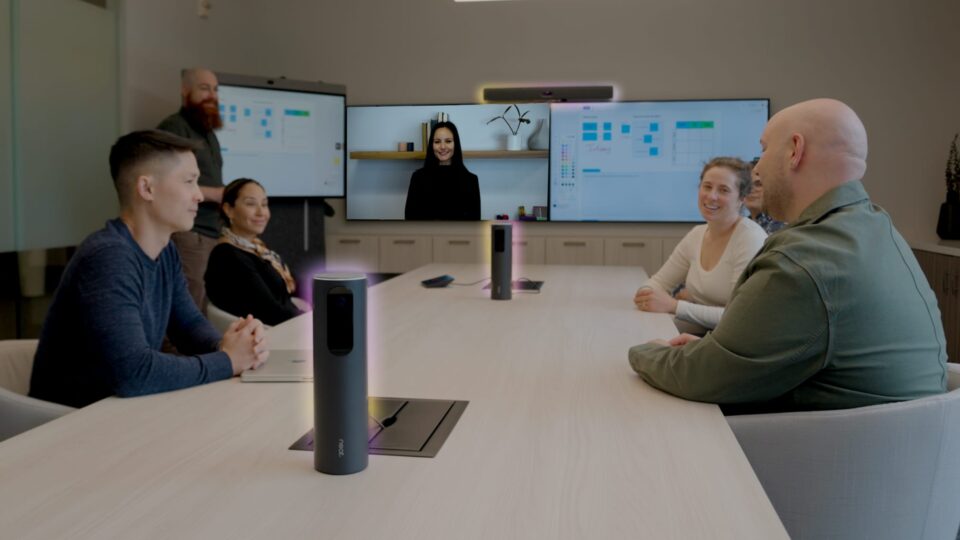
Modern meeting spaces are evolving from passive rooms into what Neat describes as thinking environments — spaces that can sense, understand, and respond naturally to human interaction in real time.
Instead of relying on isolated hardware components, distributed intelligence is embedded throughout the room.
That means devices can work together as one coordinated system:
- Cameras dynamically frame participants
- Audio adapts as conversations move
- Devices share contextual awareness
- Collaboration experiences respond naturally to how people interact
The technology becomes less visible while the meeting experience becomes more intuitive.
The goal is not simply adding AI features to rooms. It’s rethinking where intelligence lives inside the collaboration environment itself.
Why AV-over-IP matters for modern workplaces
1. Simpler scalability
Traditional AV systems often become more complex as organizations add more rooms.
AV-over-IP allows businesses to scale collaboration spaces more consistently because devices operate across standardized network infrastructure.
This creates a more flexible foundation for:
- Enterprise-wide deployments
- Global room management
- Standardized user experiences
- Easier room expansion
For IT teams, this reduces operational friction while improving consistency across locations.
2. More flexible meeting spaces
Modern workplaces are constantly evolving.
Rooms may need to support:
- Video meetings
- BYOD workflows
- Team collaboration
- Training sessions
- Multi-purpose layouts
Distributed AV architectures make it easier to adapt spaces without rebuilding entire systems.
Organizations gain flexibility without introducing unnecessary infrastructure complexity.
3. Better hybrid collaboration experiences
Hybrid collaboration depends on more than simply connecting audio and video.
Participants need to feel:
- Seen
- Heard
- Included
- Naturally connected to the conversation
AV-over-IP enables devices throughout the room to coordinate intelligently in real time.
This creates more immersive collaboration experiences where technology adapts to people instead of forcing people to adapt to technology.
4. Easier management for IT teams
Modern workplace technology must be manageable at scale.
AV-over-IP environments often support:
- Centralized device management
- Remote monitoring
- Software updates
- Faster deployment
- Simplified troubleshooting
This becomes increasingly important as organizations support larger numbers of collaboration spaces across distributed offices.
AV-over-IP vs traditional AV: What’s the difference?
| Traditional AV | AV-over-IP |
| Centralized hardware | Distributed architecture |
| Dedicated AV cabling | Standard network infrastructure |
| Fixed room configurations | Flexible and scalable spaces |
| Hardware-dependent upgrades | Software-driven adaptability |
| Manual management | Centralized remote management |
| Complex expansion | Easier scaling across locations |
Distributed intelligence is changing the future of meeting rooms
The next evolution of AV-over-IP is not simply moving signals across a network.
It’s enabling collaboration spaces that can coordinate intelligently in real time.
Neat’s distributed architecture demonstrates how intelligence embedded throughout the room can create more natural collaboration experiences. Devices contribute compute, sensing, audio, video, and contextual awareness as part of one intelligent system.
This allows meeting environments to become:
- More adaptive
- More responsive
- More inclusive
- Easier to scale
- Less dependent on centralized hardware constraints
The result is technology that fades into the background while people stay focused on collaboration.
Technology that adapts so people don’t have to.
Frequently asked questions about AV-over-IP
What does AV-over-IP stand for?
AV-over-IP stands for Audio Visual over Internet Protocol. It refers to transmitting audio, video, and control signals over a network instead of traditional AV cabling systems.
Is AV-over-IP better than traditional AV?
For many modern workplaces, yes. AV-over-IP offers greater scalability, flexibility, centralized management, and easier integration with hybrid collaboration environments.
Why are companies adopting AV-over-IP?
Organizations are adopting AV-over-IP because it simplifies deployment, supports flexible meeting spaces, improves scalability, and enables more adaptive collaboration experiences.
Does AV-over-IP require special networking equipment?
Most AV-over-IP systems operate over standard enterprise IP networks, although bandwidth, switching capacity, and network configuration remain important considerations for performance and reliability.
How does AV-over-IP support hybrid work?
AV-over-IP allows devices throughout the room to coordinate more intelligently, creating more immersive and equitable collaboration experiences for both in-room and remote participants.
The future of collaboration is distributed
Meeting rooms are no longer static environments built around isolated hardware systems.
As organizations rethink workplace collaboration, AV-over-IP is becoming the architectural foundation for more intelligent, adaptable, and future-ready thinking environments.
The most effective meeting technology will not compete for attention. It will respond naturally to how people work, collaborate, and communicate in real time.
That’s the promise of distributed intelligence, and it’s already reshaping the modern meeting room.
Where Neat fits in
Neat approaches AV-over-IP as more than a method for transporting audio and video across a network — it’s part of a broader vision for creating intelligent, adaptive “thinking environments.” Through devices like Neat Bar, Neat Board, and Neat Center, Neat distributes compute, sensing, audio, video, and contextual awareness throughout the room so devices can work together as one coordinated system. This distributed architecture helps enable more natural hybrid collaboration experiences, where cameras dynamically frame participants, audio adapts as conversations move, and technology becomes less intrusive. Combined with centralized management, platform interoperability, and software-driven adaptability, Neat’s technologies reflect the broader shift described in this article: from hardware-centric meeting rooms toward scalable, responsive collaboration environments that adapt to people — not the other way around.
Why not book a demo and experience Neat devices for yourself? Or read more about Neat AV-over-IP and why we’re different.