

A Guide to Video Kiosks: Benefits to Your Business in 2026
Hayley Spooner, Jun 10, 2026

Key takeaways
- Video kiosks have evolved from simple communication stations into intelligent digital engagement platforms that support customer service, workplace experiences, visitor management, and remote expertise.
- Advances in Artificial Intelligence (AI), cloud management, and collaboration technology have dramatically expanded what businesses can accomplish with video kiosks.
- Organizations are increasingly using video kiosks to improve customer experiences while extending access to expertise across multiple locations.
- Modern video kiosks can support virtual reception, telehealth, remote consultation, employee services, customer engagement, and self-service workflows.
- The most successful deployments focus on user experience, accessibility, and integration with existing business processes.
- Video kiosks are becoming an important component of digital transformation strategies across both customer-facing and workplace environments.
The video kiosk has been reimagined
For many years, video kiosks occupied a relatively narrow role in business technology.
They were often viewed as communication terminals—useful for connecting customers or employees with someone in another location but limited in terms of functionality and strategic value. Organizations deployed them to solve specific operational challenges, such as providing remote assistance in branch locations or extending access to specialized expertise.
That perception has changed dramatically.
In 2026, video kiosks are no longer simply tools for video communication. They have become intelligent engagement platforms that help organizations bridge physical and digital experiences. They serve as customer service hubs, virtual reception desks, employee support centers, telehealth stations, collaboration touchpoints, and increasingly, AI-powered service interfaces.
The shift reflects broader changes in how people interact with businesses. Customers expect immediate access to information. Employees want frictionless workplace experiences. Organizations are under pressure to improve service delivery while simultaneously controlling costs and operating more efficiently.
Video kiosks sit at the intersection of these demands.
They provide organizations with a flexible way to connect people with information, expertise, and services regardless of physical location. As hybrid work, distributed operations, and digital transformation continue to reshape business environments, video kiosks are becoming a valuable tool for organizations seeking to create more connected and responsive experiences.
What is a video kiosk?
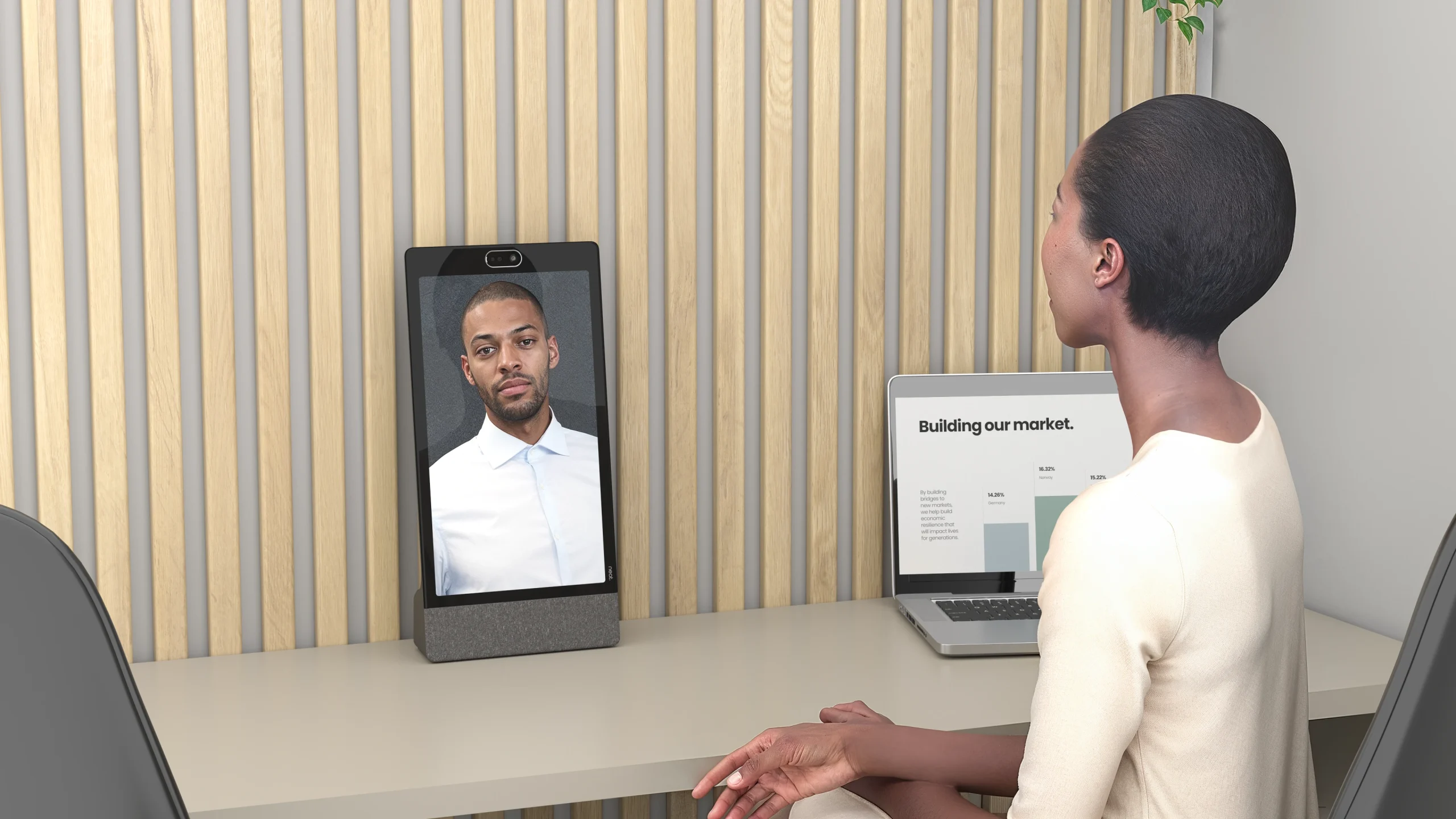
A video kiosk is a dedicated interaction point that combines video conferencing technology, cameras, microphones, displays, speakers, software, and often touchscreen functionality into a single user experience.
At its most basic level, a video kiosk allows users to communicate with someone in another location through live video. Modern systems, however, extend far beyond simple communication.
Today’s video kiosks can provide self-service experiences, connect users with remote specialists, deliver information, automate routine interactions, collect data, and integrate with broader workplace or customer experience platforms.
The result is an experience that combines the convenience of digital technology with the personal connection of face-to-face interaction.
For businesses, this creates opportunities to improve accessibility, expand service availability, and make expertise available where it is needed without requiring additional physical infrastructure.
Why businesses are investing in video kiosks
The rise of video kiosks is closely tied to changing expectations around convenience, accessibility, and responsiveness.
Whether interacting with customers, visitors, patients, students, or employees, organizations increasingly face the same challenge: people expect immediate access to support and information.
Traditional service models often struggle to meet these expectations. Staffing every location with specialized expertise is expensive and difficult to scale. Providing consistent experiences across multiple sites presents additional challenges.
Video kiosks help solve these problems by making expertise location-independent.
A customer in a retail store can connect with a product specialist located elsewhere. A patient in a rural community can access healthcare expertise without extensive travel. A visitor arriving at a corporate office can connect instantly with a host or workplace team.
This ability to distribute expertise efficiently is one of the primary reasons businesses continue investing in kiosk technology.
The benefits extend beyond cost savings. Video kiosks also help improve service consistency, increase accessibility, and reduce friction in everyday interactions.
From reception desk to intelligent experience hub
One of the most significant changes in recent years has been the evolution of the traditional reception experience.
Historically, organizations relied on physical reception desks staffed during business hours. While effective in many cases, this approach can be difficult to scale across multiple locations and often limits access to expertise.
Video kiosks provide a compelling alternative.
A modern virtual reception experience allows visitors to check in, connect with hosts, receive directions, access support, and obtain information through a combination of self-service and live assistance.
This model offers several advantages.
| Traditional reception | Video kiosk experience |
|---|---|
| Requires dedicated on-site staffing | Can support multiple locations remotely |
| Limited access to specialists | Connects visitors with distributed expertise |
| Fixed operating hours | Can extend service availability |
| Primarily location-specific | Easily scalable across sites |
| Manual visitor processes | Automated and integrated workflows |
Importantly, the goal is not necessarily to replace human interaction. Instead, video kiosks help ensure that human expertise is available where it delivers the greatest value while automating routine tasks that do not require direct intervention.
How video kiosks are being used across industries
One reason video kiosks continue to gain popularity is their versatility.
The same underlying technology can support a wide range of business objectives depending on the environment in which it is deployed.
Retail
Retail organizations increasingly use video kiosks to connect customers with product specialists, support self-service shopping experiences, and improve service availability.
Rather than requiring experts to be physically present in every store, retailers can centralize expertise while still providing personalized customer support.
Video kiosks also support endless-aisle experiences, allowing customers to access inventory information, product recommendations, and assistance that extends beyond what is available on the sales floor.
Healthcare
Healthcare providers have embraced video kiosks as a way to improve access to care and reduce administrative burdens.
Patients can use kiosks for appointment check-ins, telehealth consultations, specialist referrals, and support services. In rural or underserved communities, these capabilities can significantly improve access to healthcare resources.
Video kiosks help healthcare organizations balance patient experience, accessibility, and operational efficiency.
Education
Educational institutions are increasingly deploying kiosks to support student services, advising, enrollment processes, and campus navigation.
Students can access assistance without needing to visit multiple offices, while institutions can deliver support more consistently across larger populations.
Hospitality
Hotels and hospitality providers use video kiosks to create more convenient guest experiences.
Guests can access concierge services, request support, receive recommendations, and resolve issues without waiting in line or calling reception desks.
This creates a more responsive and flexible service model while helping organizations allocate resources more efficiently.
Corporate workplaces
Within modern workplaces, video kiosks are increasingly supporting visitor management, employee services, workplace support, and virtual reception.
As organizations continue to adopt hybrid work models, workplace experiences are becoming more distributed and flexible. Video kiosks help ensure employees and visitors can access assistance regardless of location.
Why AI is transforming the video kiosk experience
Artificial intelligence is rapidly reshaping what businesses expect from video kiosks.
Historically, every interaction required direct human involvement. Today, AI can support many tasks independently while escalating more complex issues to the appropriate expert when necessary.
This shift allows organizations to deliver faster, more scalable service experiences without sacrificing quality.
Modern AI-powered kiosks may support:
- Conversational interactions
- Natural language processing
- Intelligent routing
- Automated information retrieval
- Multilingual experiences
- Personalized recommendations
- Knowledge-base integration
Imagine a visitor arriving at a workplace. Rather than immediately connecting with a receptionist, the visitor interacts with an AI assistant that verifies information, provides directions, and determines whether additional support is required.
Similarly, a customer seeking product information may receive answers instantly through AI while retaining the option to connect with a live specialist if needed.
The combination of AI and human expertise creates a more efficient service model that balances automation with personal interaction.
The new challenge: Creating connected physical spaces
Perhaps the most important trend shaping video kiosks in 2026 is the growing need to connect physical and digital environments.
Organizations increasingly recognize that physical spaces should not operate independently from digital experiences.
Customers move fluidly between online and offline interactions. Employees expect workplace services to be available regardless of location. Visitors want immediate access to information and assistance.
Video kiosks help bridge these worlds.
They transform physical spaces into connected touchpoints capable of delivering digital services, remote expertise, and intelligent interactions.
As businesses continue investing in customer experience, employee experience, and workplace transformation initiatives, the role of the video kiosk is expanding beyond communication into a broader category of digital engagement.
What should businesses look for in a video kiosk solution?
Not all video kiosk solutions are created equal.
Organizations evaluating options should focus on the user experience first and the technology second.
The most successful deployments share several characteristics.
| Consideration | Why it matters |
|---|---|
| Ease of Use | Encourages adoption and engagement |
| Audio and Video Quality | Supports effective communication |
| Scalability | Enables deployment across multiple locations |
| Remote Management | Simplifies administration and support |
| Security | Protects sensitive information |
| Accessibility | Ensures inclusivity for all users |
| AI Capabilities | Supports future innovation |
Organizations should also consider how kiosks integrate into broader workflows and technology ecosystems.
The best solution is not necessarily the one with the longest feature list. It is the one that fits naturally into the experiences users already expect.
Where Neat fits in
As organizations increasingly look for ways to connect people, services, and expertise across physical and digital environments, the quality of the interaction experience becomes critically important.
Neat’s portfolio is particularly well suited to modern video kiosk and virtual reception scenarios because it combines simplicity, high-quality collaboration technology, and intuitive design.
Devices such as Neat Frame can serve as elegant visitor engagement points, virtual reception systems, customer support stations, and employee service touchpoints. Its integrated camera, microphone array, speaker system, and touch-enabled interface create a natural experience that requires minimal training for users.
For more interactive environments, Neat Board 50 or Neat Board Pro offers a larger collaborative experience that can support customer engagement, workplace interactions, and information-sharing use cases.
Importantly, Neat’s focus on simplicity aligns closely with the needs of kiosk deployments. Visitors, customers, and employees interacting with kiosks often have no prior familiarity with the technology. Reducing friction is therefore essential.
For organizations managing deployments across multiple locations, Neat Pulse provides centralized visibility and management capabilities that help IT teams maintain consistency while simplifying administration.
As businesses continue to invest in workplace transformation, visitor experience, and digital engagement strategies, solutions that combine collaboration, accessibility, and simplicity will become increasingly valuable. Neat’s approach positions it well within this evolving landscape.
Book a demo or explore our range of devices today.
Frequently asked questions
What is a video kiosk?
A video kiosk is a dedicated interaction point that combines video conferencing technology, displays, cameras, microphones, speakers, and software to connect users with information, services, or remote experts.
What are video kiosks used for?
Organizations use video kiosks for customer service, virtual reception, telehealth, employee support, visitor management, education services, and remote consultation.
How does a video kiosk differ from a traditional kiosk?
Traditional kiosks typically focus on self-service tasks. Video kiosks add live communication capabilities, allowing users to connect directly with remote experts and support teams.
Can video kiosks use artificial intelligence?
Yes. Many modern video kiosks use AI to support conversational interactions, answer questions, route requests, provide information, and improve overall user experiences.
Are video kiosks suitable for hybrid workplaces?
Absolutely. Many organizations use video kiosks to support visitor management, employee services, virtual reception, and workplace support within hybrid environments.
What should businesses prioritize when choosing a video kiosk solution?
Ease of use, audio and video quality, scalability, remote management, accessibility, security, and integration capabilities should all be considered during the evaluation process.
Sources
- Gartner Research: https://www.gartner.com
- IDC Research: https://www.idc.com
- Frost & Sullivan: https://www.frost.com
- McKinsey Insights: https://www.mckinsey.com
- McKinsey: https://www.mckinsey.com/capabilities/tech-and-ai/our-insights
- Microsoft Documentation: https://learn.microsoft.com
- Zoom Workplace Resources: https://explore.zoom.us