


What Security Looks Like in the AI Era
Steve Odegaard, Jun 25, 2026

The AI security conversation is getting louder. But the most important question remains: was security built into the product from the start, and does it continue to evolve as threats change?
Projects like Anthropic’s Glasswing have put a spotlight on a reality security teams already understand: AI can now identify vulnerabilities at a speed and scale that would have seemed impossible just a few years ago. The same technologies helping defenders find weaknesses are giving attackers new tools as well.
For technology vendors, the implications are straightforward. The window between discovering a flaw and exploiting it is shrinking. In some cases, the gap between identifying a weakness and understanding how it could be exploited is approaching near-zero. As that window narrows, security programs built around periodic reviews and reactive patching come under increasing pressure.
Some companies have responded by treating participation in the latest AI security initiative as proof of security maturity. We see it differently.
Customers aren’t protected by association. They’re protected by architecture, engineering discipline, operational rigor, and the ability to respond quickly when new threats emerge. What AI is changing is the speed of security, not the direction of our strategy. The foundations we’ve invested in for years are more relevant today than ever.
Neat was founded in 2019, and security has been central to how we’ve designed, built, and operated our products ever since. Our strategy has always been shaped by the expectation that threats would become faster, attack surfaces would continue to expand, and software vendors would need to operate with continuous vigilance rather than periodic checkpoints. AI has accelerated those trends, but it didn’t create them. That’s why we believe customers should look past the announcements and ask a more important question: how is the product actually secured?
Designed from the start
The answer starts with the device itself. Neat OS is a purpose-built operating system designed specifically for meeting spaces. While it’s built on the Android Open Source Project, it isn’t a consumer Android device repackaged for enterprise use. It’s a hardened platform engineered for a specific purpose, with hardware-backed secure boot, verified operating system integrity, anti-rollback protections, hardware-isolated key storage, and strict process controls that limit what software can access, even if a vulnerability is discovered elsewhere.
Those foundations become even more important as devices gain AI capabilities. Features such as meeting transcription, summaries, and intelligent sensing naturally increase the amount of information being processed, which is why we treated privacy and security as design requirements from the beginning rather than controls added later.
The difference is significant. When AI capabilities are built with data minimization, encryption, consent, and processing boundaries already defined, the resulting architecture is fundamentally stronger than one retrofitted after launch. The same philosophy extends beyond the device itself.
Deliberate decisions
Neat Pulse, our cloud management platform, is built on a defense-in-depth architecture designed to provide visibility, control, and resilience at scale. Data is encrypted in transit and at rest. Infrastructure is isolated using cloud-native security controls. Monitoring operates continuously, not just during business hours.
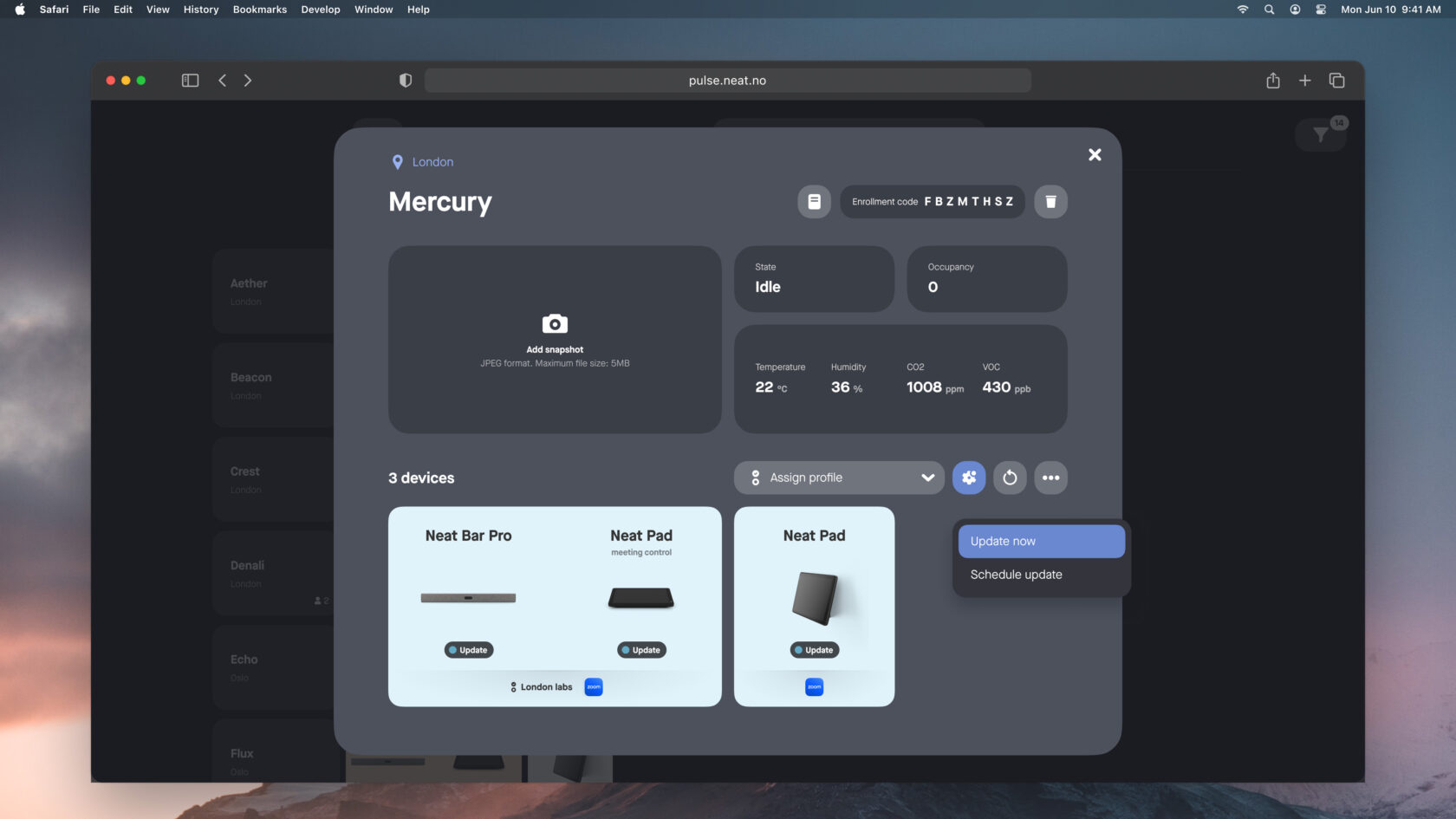
We’ve also made deliberate decisions about identity and access. Neat Pulse doesn’t store customer passwords. Authentication is delegated to trusted identity providers, allowing organizations to maintain control of their own identity ecosystem while reducing risk.
Security at machine speed
As AI accelerates threat activity, operational speed becomes just as important as architecture.
That’s why AI-assisted code analysis is incorporated throughout our software development lifecycle. It helps identify issues earlier, before they reach production. Combined with continuous integration and delivery processes, it allows updates and security improvements to move quickly when required.
In an environment where threats evolve rapidly, resilience depends on how quickly organizations can identify issues, understand their impact, and respond. Our focus is on continuously shortening the distance between discovery and remediation.
We are applying the same thinking to our own security operations. Traditional security programs often relied heavily on scheduled audits and point-in-time assessments. Those remain valuable, but they are no longer sufficient on their own. Continuous monitoring, ongoing vulnerability management, stronger supply-chain scrutiny, and phishing-resistant authentication are increasingly important when attackers can use AI to amplify their efforts.
Every integration changes the equation
We build our security program around a reality that’s becoming increasingly clear: the advantage between defenders and attackers is narrowing. That assumption drives investment, testing, and decision-making across the company. It also shapes how we tackle emerging AI integrations.
As organizations experiment with AI assistants and automation, new access paths inevitably appear. The challenge is ensuring those integrations do not introduce unnecessary risk. New capabilities should inherit existing security controls whenever possible, remain transparent to administrators, and provide clear boundaries around access. Security should be part of the design, not an afterthought once adoption begins.
After the headlines fade
AI is changing the security industry in meaningful ways, but it hasn’t changed the principles that determine whether a product is secure. Strong architecture, disciplined engineering, continuous vigilance, rapid response, and clear accountability remain the foundations of effective security programs. Those principles were guiding our decisions long before AI became the industry’s dominant conversation, and they continue to guide it today.
For organizations evaluating technology partners, the most useful question is not whether a vendor is attached to the latest AI security initiative. It’s whether security is embedded deeply enough into everything they build to withstand whatever comes next.
At Neat, that’s been our focus all along.
Want to learn more about how Neat designs secure meeting experiences? Explore our video devices, join a live virtual demo, or book a one-on-one session with our team.