

Conference Table Size Guide: How to Choose the Right Meeting Room Table in 2026
Hayley Spooner, Jul 16, 2026
Key takeaways
- The right conference table balances room size, seating capacity, and collaboration needs.
- Allow sufficient clearance around the table to improve comfort, accessibility, and movement.
- Table shape influences collaboration, visibility, and overall room capacity.
- Hybrid meeting rooms should be designed around meeting equity—not just seating arrangements.
- AI-ready meeting spaces require thoughtful placement of displays, cameras, and collaboration technology.
- Flexible room layouts help meeting spaces adapt to different types of work throughout the day.
- Meeting room furniture should support collaboration technology, not compete with it.
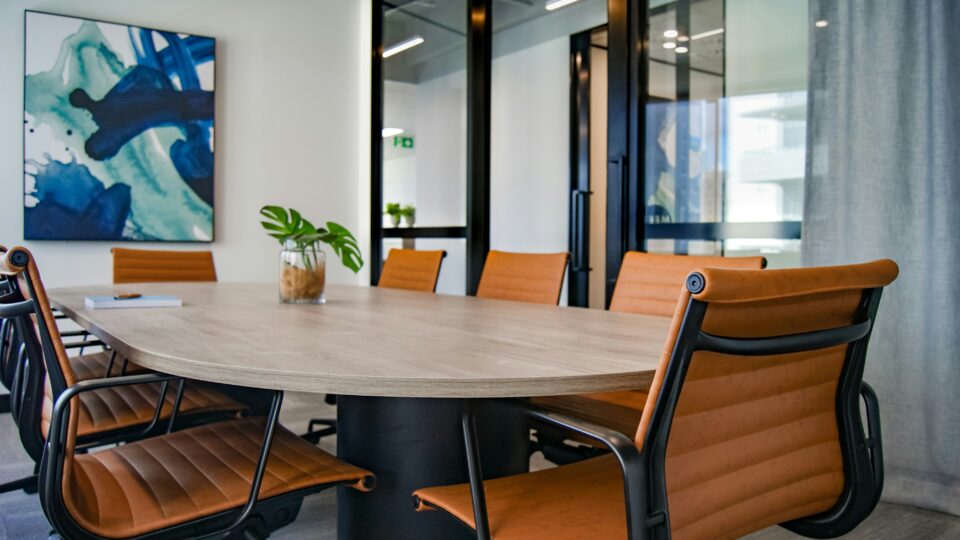
The conference table is often the focal point of a meeting room, but choosing the right one involves far more than deciding how many people it can seat.
Today’s conference rooms need to support a wide variety of activities, from presentations and brainstorming sessions to customer meetings and hybrid collaboration with remote participants. That means furniture, technology, and room layout all need to work together to create productive meeting experiences.
Research from JLL’s Workplace Design and Trends highlights the growing importance of creating workplaces that support collaboration, flexibility, and employee experience. As organizations continue to invest in hybrid work, conference room design has become a strategic consideration rather than simply a facilities decision.
This guide explains how to choose the right conference table size, how different table shapes influence collaboration, and how to design meeting rooms that support today’s hybrid workforce while remaining ready for the future.
Why conference table size matters
The best conference table is one that supports the meeting—not one that simply fills the room.
Choosing the right conference table affects far more than seating capacity. It influences how people communicate, how comfortably they can work, and how effectively meeting room technology performs.
A table that’s too large can make conversations feel disconnected, restrict movement, and create poor sightlines for remote participants. A table that’s too small may leave attendees feeling cramped and reduce space for laptops, documents, or collaborative work.
The right balance creates an environment where people can interact naturally while making efficient use of available office space.
When selecting a conference table, consider:
- Room dimensions
- Typical meeting size
- Hybrid meeting requirements
- Accessibility
- Technology placement
- Future workplace flexibility
Rather than maximizing the number of seats, organizations should focus on creating spaces that encourage productive collaboration.
How to choose the right conference table size
Conference table size should be driven by how people collaborate—not simply by how many people the room can hold.
Many organizations begin by estimating the maximum occupancy of a meeting room. While this provides a useful starting point, it’s equally important to consider how the room will be used on a day-to-day basis.
For example, if most meetings involve six people but the room occasionally hosts ten, it may be better to optimize the layout for the more common scenario rather than choosing an oversized table that dominates the space.
Several factors should influence your decision.
Room dimensions
Start by measuring the available room space.
People need sufficient clearance to move comfortably around the table, pull out chairs, and access doors, displays, and whiteboards.
As a general guideline, allow at least 48 inches (122 cm) of clearance between the edge of the table and surrounding walls or furniture. Larger executive spaces may benefit from even greater clearance.
Typical meeting attendance
Choose a table that reflects how the room is typically used rather than its maximum capacity.
If a room regularly hosts four to six people, a smaller table will often create a more comfortable and collaborative environment than one designed for twelve participants.
Hybrid collaboration
Modern conference rooms should also accommodate remote participants.
This means leaving adequate space for displays, collaboration devices, cameras, and sightlines so everyone can see shared content and participate naturally in the discussion.
The conference table should work with your collaboration technology—not compete with it.
Future flexibility
Hybrid work continues to evolve, and meeting spaces increasingly need to support different activities throughout the day.
Choosing furniture that allows layouts to adapt over time can help organizations maximize long-term value from their meeting rooms.
Conference table size guide
The table below provides general guidance for selecting an appropriate conference table based on room size and seating capacity.
| Number of people | Typical table length | Recommended room size |
| 4–6 | 72–84 in (183–213 cm) | 14 × 12 ft (4.3 × 3.7 m) |
| 6–8 | 96 in (244 cm) | 16 × 12 ft (4.9 × 3.7 m) |
| 8–10 | 120 in (305 cm) | 18 × 12 ft (5.5 × 3.7 m) |
| 10–12 | 144 in (366 cm) | 20 × 12 ft (6.1 × 3.7 m) |
| 12–16 | 168–192 in (427–488 cm) | 22–24 × 13 ft (6.7–7.3 × 4 m) |
These dimensions should be treated as general recommendations rather than fixed rules. Factors such as table shape, room layout, and collaboration technology can all influence the ideal configuration.
How much space should each person have?
Giving people enough personal workspace improves both comfort and collaboration.
One of the most common conference room design mistakes is focusing on the number of chairs rather than the amount of usable workspace available to each participant.
Modern meetings often involve laptops, notebooks, mobile devices, and shared documents. Providing sufficient space allows attendees to work comfortably while reducing distractions.
The following guidelines can help.
| Space per person | Best suited to |
| 30 in (76 cm) | Maximum seating capacity |
| 36 in (91 cm) | Everyday team meetings |
| 42 in (107 cm) | Laptop-heavy collaboration |
| 48 in (122 cm) | Executive meetings and workshops |
Choosing slightly fewer seats often creates a better overall meeting experience than trying to maximize capacity.
Choosing the right table shape
The shape of your conference table influences collaboration just as much as its size.
Different table shapes encourage different styles of interaction and are better suited to different room layouts.
Rectangular tables
Rectangular tables remain the most common choice for conference rooms because they use space efficiently and provide clear sightlines toward displays at the front of the room.
They work particularly well for presentations, formal meetings, and larger groups.
Best for:
- Boardrooms
- Client meetings
- Hybrid presentations
- Larger meeting rooms
Boat-shaped tables
Boat-shaped tables are wider in the middle and narrower at each end.
This subtle shape helps improve visibility between participants while creating a more open feel than a traditional rectangular table.
They’re often used in executive meeting rooms where collaboration and presentation are equally important.
Best for:
- Executive meetings
- Strategy sessions
- Hybrid boardrooms
Round tables
Round tables encourage equal participation because every attendee sits at a similar distance from one another.
They’re particularly effective for discussions, brainstorming sessions, and smaller team meetings where conversation is the primary objective.
Best for:
- Creative collaboration
- Informal meetings
- Team discussions
Racetrack tables
Racetrack tables combine the efficiency of a rectangular table with the softer appearance of rounded ends.
They’re popular in modern conference rooms because they improve circulation around the table while maintaining good seating capacity.
Best for:
- Medium-sized meeting rooms
- Hybrid collaboration
- Multi-purpose meeting spaces
Modular tables
Modular conference tables provide the greatest flexibility.
Individual sections can be rearranged into different layouts depending on the activity, making them particularly well suited to agile workplaces where meeting spaces regularly change throughout the day.
Best for:
- Flexible workspaces
- Workshops
- Training rooms
- Collaborative project spaces
Designing for hybrid meetings
The most effective conference rooms are designed around people—not just furniture.
Hybrid work has fundamentally changed how meeting rooms should be planned. Today, every conference room needs to support participants who are physically present and those joining remotely, creating a consistent experience for everyone regardless of location.
This means conference table size is only one part of the design process. Sightlines, camera placement, displays, acoustics, and collaboration technology all contribute to the quality of the meeting.
When designing a hybrid meeting room, consider the following principles.
Prioritize meeting equity
Meeting equity means ensuring remote participants can contribute as naturally as those sitting around the table.
Everyone should be able to:
- See every participant clearly
- Hear conversations without distractions
- View shared content comfortably
- Contribute without feeling like an observer
The physical layout of the room—including the conference table—plays an important role in achieving this.
Think about camera placement
The conference table should support the camera rather than obstruct it.
Avoid layouts where participants sit too far away, block one another from view, or create awkward sightlines. Choosing an appropriately sized table helps cameras capture everyone more naturally while allowing intelligent framing technologies to perform effectively.
Support AI-ready collaboration
Artificial intelligence is becoming part of everyday meetings.
Meeting summaries, live transcription, intelligent framing, speaker identification, and AI-powered assistants all depend on high-quality audio and video capture. Designing the room around these capabilities today helps future-proof collaboration spaces as AI continues to evolve.
Reduce meeting friction
Employees increasingly expect meetings to begin instantly.
Simple room layouts, integrated collaboration devices, wireless content sharing, and intuitive controls all help reduce the delays caused by cables, adapters, and complex AV systems.
The easier a meeting room is to use, the more likely employees are to use it effectively.
Common conference table mistakes
Small design decisions can have a significant impact on meeting quality.
Even thoughtfully designed meeting rooms can become less effective if the conference table doesn’t support how people actually work.
Some of the most common mistakes include:
- Choosing a table based only on maximum occupancy
- Leaving insufficient clearance around the table
- Ignoring camera positioning and sightlines
- Blocking displays with oversized furniture
- Forgetting power, charging, and cable management
- Selecting furniture before planning collaboration technology
- Prioritizing aesthetics over usability
Avoiding these common issues helps create meeting spaces that are comfortable, flexible, and ready for hybrid collaboration.
Conference room trends shaping 2026
Conference rooms are becoming intelligent collaboration environments rather than static meeting spaces.
Several trends are influencing how organizations design meeting rooms today.
AI-ready meeting rooms
Artificial Intelligence is transforming collaboration through intelligent framing, meeting summaries, transcription, workflow automation, and AI assistants.
Meeting rooms increasingly need to provide the high-quality audio and video experiences that allow these tools to deliver accurate and useful results.
Flexible furniture
Organizations are moving away from fixed-purpose meeting rooms toward adaptable spaces that can support presentations, workshops, brainstorming sessions, customer meetings, and hybrid collaboration using the same furniture.
Meeting equity
Modern conference rooms are designed so remote participants feel just as connected to conversations as colleagues sitting around the table.
Meeting equity is becoming a core design principle rather than simply a technology feature.
Integrated collaboration technology
Rather than assembling multiple separate AV components, many organizations are choosing integrated collaboration devices that simplify deployment, management, and everyday use.
Research from The International WELL Building Institute (IWBI) also highlights the importance of workplace environments that support employee wellbeing, comfort, and productivity—factors that increasingly influence how meeting spaces are designed.
Where Neat fits in
The best meeting rooms aren’t designed around technology—they’re designed around the people using it.
Choosing the right conference table is only one part of creating an effective meeting room. The layout, furniture, displays, cameras, and collaboration technology all need to work together to support productive conversations and inclusive hybrid meetings.
This philosophy sits at the heart of Neat’s approach to meeting room design. Rather than treating cameras, microphones, speakers, and collaboration tools as separate components, Neat creates integrated meeting experiences that reduce complexity while helping everyone feel more connected.
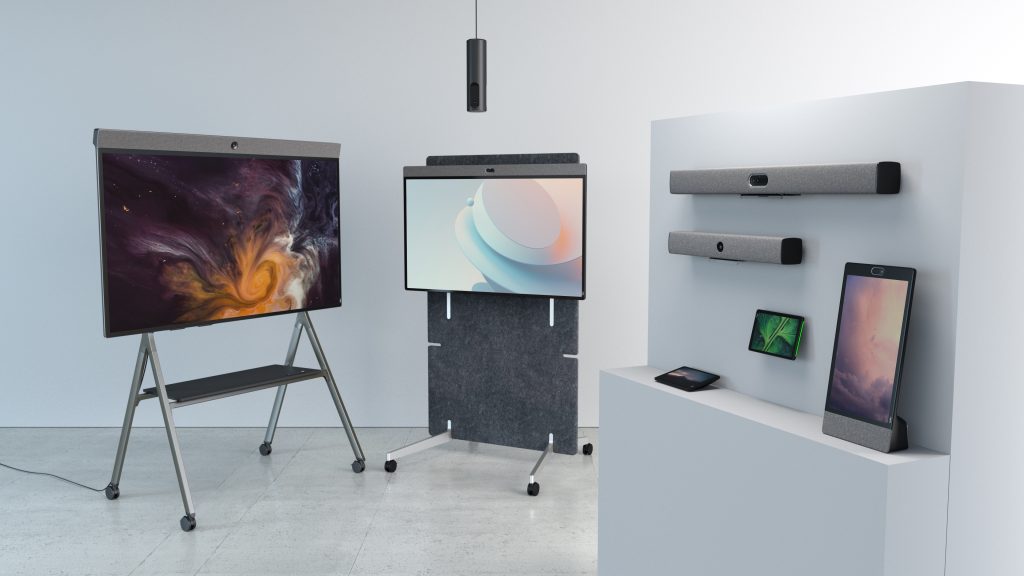
For small and medium-sized meeting rooms, Neat Bar Generation 2 combines a 50 MP camera, intelligent framing, adaptive audio processing, dual-screen support, and flexible mounting options into a single collaboration device. Its compact design makes it easier to create clean meeting room layouts while ensuring participants can be seen and heard clearly, without compromising table placement or room aesthetics.
For larger meeting spaces where interactive collaboration is equally important, Neat Board 50 combines a 50-inch multi-touch display, intelligent camera, speakers, microphones, wireless content sharing, and digital whiteboarding into a single all-in-one device. This integrated approach helps reduce cable clutter and simplifies room design while giving teams the flexibility to move naturally between presentations, brainstorming sessions, and hybrid meetings.
As organizations increasingly adopt AI-powered collaboration, flexibility is becoming just as important as functionality. Through Neat Open, organizations can choose the collaboration platforms, applications, and AI experiences that best suit their business while maintaining a consistent meeting room experience that can evolve alongside changing workplace needs.
Underlying every Neat solution are Neat’s proprietary technologies including intelligent framing, adaptive audio, and meeting equity features that continuously optimize meetings without requiring users to think about the technology itself.
By combining thoughtful room design with intelligent collaboration technology, Neat helps organizations create conference rooms that are easier to use, easier to manage, and better prepared for the future of hybrid work.
Perhaps it’s time to book a demo and experience them for yourself.
Frequently asked questions
What size conference table do I need?
The right conference table depends on your room size, typical meeting attendance, and how the space is used. Rather than choosing the largest table that fits, select one that provides comfortable seating, sufficient clearance, and space for collaboration technology.
How much space should you leave around a conference table?
A minimum of 48 inches (122 cm) of clearance between the table and surrounding walls or furniture is generally recommended. This allows people to move comfortably, pull out chairs, and access displays and doors.
What is the standard conference table height?
Most conference tables are approximately 29–30 inches (74–76 cm) high, providing a comfortable working height for meetings involving laptops, note-taking, and collaboration.
Which conference table shape is best?
There isn’t a single best shape. Rectangular tables work well for presentations, round tables encourage discussion, boat-shaped tables improve sightlines, and modular tables provide maximum flexibility. The right choice depends on how the room will be used.
How many people fit around a conference table?
This depends on the table dimensions, but allowing 30–36 inches (76–91 cm) of width per person generally provides comfortable seating for everyday meetings.
How do you design a conference room for hybrid meetings?
Successful hybrid meeting rooms balance furniture, technology, lighting, acoustics, and room layout. Conference tables should support good camera placement, clear sightlines, meeting equity, and easy collaboration between in-person and remote participants.
Should meeting room technology influence table size?
Yes. Modern collaboration technology should be considered early in the design process. Conference tables should complement displays, cameras, microphones, and content-sharing solutions rather than obstructing them.
Sources
- Workplace Design and Trends, JLL, https://www.jll.com/en/trends-and-insights/workplace
- How to Choose the Right Size Conference Table, ArcGrove, https://www.arcgrove.com/blogs/posts/how-to-choose-the-right-size-conference-table
- The Complete Conference Room Setup Guide, Gable, https://www.gable.to/blog/post/the-complete-conference-room-setup-guide
- The WELL Standard, International WELL Building Institute, https://www.wellcertified.com/