

The Best Hybrid Meeting Technology in 2026: What Actually Makes Remote Participants Feel Present
Hayley Spooner, May 27, 2026
Quick answer: What is the best hybrid meeting technology in 2026?
The best hybrid meeting technology in 2026 creates collaboration experiences where remote participants feel naturally included, visible, and connected in real time.
Modern hybrid meeting technology goes beyond basic video conferencing. Organizations are now prioritizing intelligent collaboration environments that combine adaptive video, responsive audio, distributed intelligence, and seamless room experiences to reduce meeting friction and improve collaboration equity.
The most effective systems help technology fade into the background so meetings can move naturally.
Why hybrid meetings still fail in many workplaces
Hybrid work is now a permanent part of how organizations operate.
But despite years of investment in collaboration platforms and conference room upgrades, many hybrid meetings still feel fragmented.
Remote participants often experience:
- Poor visibility into room conversations
- Inconsistent audio pickup
- Static camera angles
- Delayed interaction
- Difficulty contributing naturally
- Reduced engagement during discussions
In many meeting rooms, technology still behaves like a passive broadcasting system rather than an active collaboration environment. This disconnect creates an uneven experience between in-room and remote attendees.
As organizations evaluate the best hybrid meeting technology in 2026, the focus is shifting toward creating meeting environments that adapt dynamically to people and collaboration in real time.
What defines the best hybrid meeting technology?
The best hybrid meeting technology is no longer defined only by camera resolution or microphone specifications.
Organizations are increasingly evaluating systems based on how effectively they create natural collaboration experiences for everyone in the meeting.
Key characteristics of modern hybrid meeting technology
| Capability | Why It Matters |
| Dynamic framing | Keeps participants naturally visible throughout conversations |
| Adaptive audio | Improves clarity as people move and discussions shift |
| Distributed intelligence | Enables devices to coordinate seamlessly across the room |
| AI-assisted responsiveness | Helps meetings adapt in real time |
| Simplicity for users | Reduces friction during meetings |
| Scalability for IT teams | Simplifies deployment and management |
| Platform interoperability | Supports evolving workplace workflows |
The goal is not to add more visible technology into the room. The goal is to create collaboration experiences that feel seamless, immersive, and intuitive.
Why remote participants often feel disconnected
Traditional meeting rooms were designed around the physical room itself. Hybrid collaboration changes the equation entirely. Today, every participant — regardless of location — needs to feel equally present in the conversation. This becomes difficult when meeting rooms rely on:
- Fixed camera positions
- Single-direction audio pickup
- Manual controls
- Static room layouts
- Centralized infrastructure
When room systems cannot adapt dynamically, remote attendees become observers instead of active participants.
The best hybrid meeting technology addresses this challenge by creating environments that continuously respond to conversation flow, movement, and collaboration behavior in real time.
Artificial Intelligence (AI)
Artificial intelligence is becoming foundational to modern hybrid collaboration experiences. But the most effective AI in meeting rooms is often the least noticeable.
Rather than overwhelming users with visible automation features, intelligent collaboration systems use AI to support more natural interaction behind the scenes. This includes:
- Real-time room awareness
- Intelligent participant framing
- Audio optimization
- Context-aware responsiveness
- Adaptive collaboration experiences
The purpose of AI in hybrid meetings is not to distract from collaboration. It is to help technology adapt so people do not have to.
In future-ready thinking environments, intelligence is embedded throughout the room rather than isolated inside a single device or feature set. This distributed approach enables meeting spaces to respond continuously to how people communicate and collaborate.
How AI improves hybrid meetings
| AI Capability | Collaboration Benefit |
| Real-time participant recognition | More natural framing and visibility |
| Audio coordination | Clearer conversations across the room |
| Adaptive room behavior | Reduced manual adjustments |
| Intelligent responsiveness | Meetings flow more naturally |
| Context awareness | Better collaboration equity |
Organizations evaluating the best hybrid meeting technology increasingly prioritize AI that feels invisible, intuitive, and human-centered.
Dynamic framing
One of the biggest frustrations in hybrid meetings is poor participant visibility. Static camera systems often fail to capture the natural flow of conversation, especially in larger or more active meeting spaces.
Dynamic framing changes this experience. Instead of relying on fixed camera views, intelligent framing continuously adapts based on participant movement and interaction throughout the room. This helps remote attendees stay visually connected to the discussion as it evolves.
Benefits of dynamic framing
- Keeps speakers naturally visible
- Improves engagement for remote participants
- Reduces awkward camera transitions
- Supports more fluid collaboration
- Helps conversations feel more immersive
In modern thinking environments, framing should feel responsive rather than mechanical. The best hybrid meeting technology creates transitions that feel natural and unobtrusive so meetings can maintain momentum without distraction.
This becomes especially important in collaborative spaces where participants move between presentations, brainstorming, and group discussion throughout the meeting.
Adaptive audio
Audio quality remains one of the most important factors in hybrid meeting effectiveness. Even small disruptions in clarity can reduce participation and increase meeting fatigue.
Traditional conference room audio systems often struggle in dynamic environments because they rely on fixed pickup zones or static processing models. Adaptive audio takes a different approach.
Intelligent audio systems continuously respond to:
- Speaker location
- Room movement
- Conversation flow
- Environmental changes
- Participant interaction
This enables more natural communication throughout the meeting space.
Why adaptive audio matters
| Traditional Audio Systems | Adaptive Audio Systems |
| Fixed pickup behavior | Real-time responsiveness |
| Uneven participant clarity | More balanced conversations |
| Manual optimization | Automated coordination |
| Limited flexibility | Dynamic room adaptation |
| Static processing | Intelligent collaboration awareness |
Adaptive audio helps remote participants feel less separated from the room itself. By coordinating audio intelligently throughout the environment, conversations become easier to follow and more inclusive for everyone involved.
Distributed intelligence and the future of hybrid collaboration
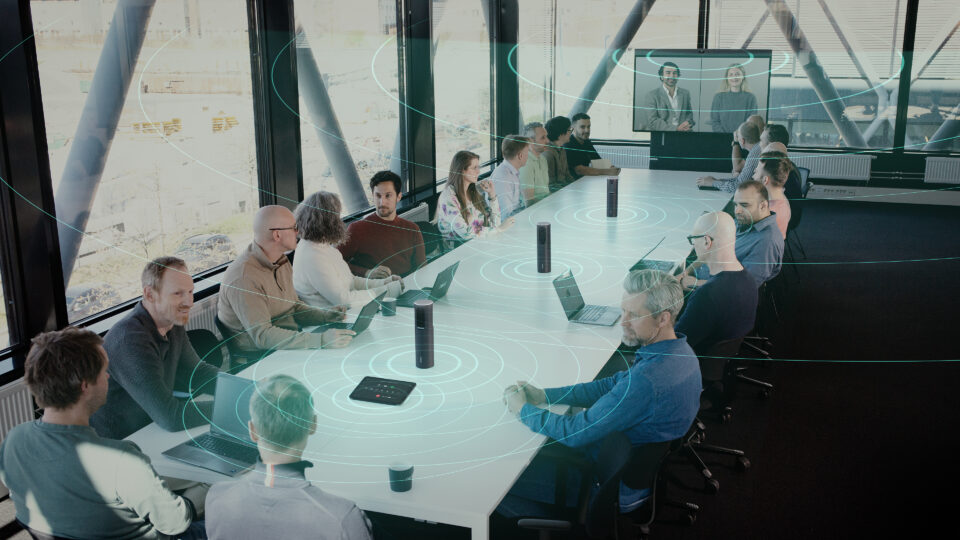
The best hybrid meeting technology in 2026 increasingly relies on distributed intelligence. Rather than centralizing all processing into a single room device, distributed systems embed intelligence throughout the collaboration environment. This creates several important advantages:
- Faster responsiveness
- Greater room flexibility
- Easier scalability
- Simplified infrastructure
- More immersive collaboration experiences
Devices can coordinate dynamically across the room to adapt to real-time meeting behavior. This architectural shift is helping organizations move beyond traditional conference rooms toward thinking environments designed around people rather than hardware.
What organizations should look for in hybrid meeting technology
As workplace collaboration evolves, organizations should evaluate hybrid meeting technology based on long-term usability and collaboration quality rather than isolated specifications alone.
Key evaluation criteria
1. Natural collaboration experiences
Technology should support meetings without interrupting them.
2. Meeting equity
Remote participants should feel equally included and visible.
3. Scalability
Systems should support deployment across multiple room types and locations.
4. Simplicity
Room experiences should feel intuitive for both users and IT teams.
5. Adaptability
Meeting environments should evolve alongside changing workplace needs.
How Neat approaches hybrid collaboration differently
Neat’s collaboration platform is designed around the idea that meeting spaces should understand collaboration rather than simply capture it.
Its intelligent distributed architecture enables devices to coordinate seamlessly throughout the room to create adaptive collaboration experiences.
This includes:
- Dynamic framing
- Adaptive audio coordination
- Real-time responsiveness
- Simplified deployment
- Seamless platform experiences
Neat’s vision for thinking environments focuses on creating spaces where technology fades into the background so people can collaborate more naturally.
As hybrid work continues to evolve, organizations increasingly need meeting technology that feels less like operating hardware and more like entering an environment designed for communication.
That is the direction intelligent collaboration is moving.
Where Neat fits in
As organizations rethink what defines the best hybrid meeting technology, the conversation is shifting beyond standalone devices and toward intelligent collaboration environments that adapt naturally to people.
This is where Neat’s approach stands apart. Neat is helping transform passive meeting rooms into thinking environments — spaces designed to sense, understand, and respond in real time to how people collaborate.
Rather than relying on traditional centralized room systems, Neat uses distributed intelligence embedded throughout the meeting environment. Devices coordinate seamlessly across the room to create adaptive collaboration experiences that feel more natural, immersive, and intuitive.
This architecture supports several important advantages for modern workplaces:
| Neat approach | Workplace impact |
| Distributed intelligence | More responsive and adaptive meeting experiences |
| Real-time room awareness | Better collaboration flow and meeting equity |
| Dynamic framing | More natural visibility for remote participants |
| Adaptive audio coordination | Clearer and more balanced conversations |
| Simplified deployment | Easier scalability across rooms and locations |
| Human-centered design | Technology fades into the background |
Neat’s vision reflects a broader evolution in workplace collaboration. The future of hybrid meetings is not about adding more visible technology into conference rooms. It is about creating environments where intelligence is embedded throughout the space so collaboration happens more naturally.
This aligns closely with how modern organizations are evaluating collaboration technology in 2026:
- Can remote participants feel truly present?
- Does the room adapt dynamically to conversation flow?
- Can meeting experiences scale without adding complexity?
- Does technology support collaboration without becoming the focus?
Neat’s thinking environment model is designed around these realities. Instead of forcing users to manage complicated room systems, Neat prioritizes seamless and intuitive collaboration experiences where technology adapts so people do not have to.
As hybrid work continues to evolve, organizations increasingly need meeting spaces that are flexible, responsive, and future-ready. That is the role thinking environments are designed to play.
Frequently asked questions
What is the best hybrid meeting technology in 2026?
The best hybrid meeting technology creates seamless, immersive collaboration experiences where remote participants feel naturally included through adaptive audio, dynamic framing, distributed intelligence, and intuitive room interaction.
Why do remote participants often feel disconnected in hybrid meetings?
Many traditional meeting rooms rely on static cameras, fixed audio systems, and centralized infrastructure that cannot adapt dynamically to how conversations evolve.
What is dynamic framing in hybrid meetings?
Dynamic framing automatically adjusts camera composition in real time to keep participants naturally visible throughout discussions and movement within the room.
What is adaptive audio?
Adaptive audio continuously responds to speaker location, room activity, and conversation flow to improve clarity and create more balanced communication experiences.
How is AI used in modern meeting rooms?
AI helps meeting environments respond intelligently to participant behavior, room conditions, framing, and audio coordination to support more natural collaboration experiences.
What are thinking environments?
Thinking environments are collaboration spaces designed to sense, understand, and adapt in real time to improve hybrid meeting experiences and reduce technology friction.
Key takeaways
- The best hybrid meeting technology prioritizes collaboration experience over hardware complexity
- Remote participant inclusion is now a core workplace technology priority
- AI should support natural interaction rather than create distractions
- Dynamic framing and adaptive audio improve meeting equity significantly
- Distributed intelligence enables more responsive and scalable collaboration environments
- The future of workplace collaboration is moving toward adaptive thinking environments where technology fades into the background
Why not book a demo and experience Neat devices for yourself? Or read more about Neat AV-over-IP and why we’re different.